For U.S. women figure skaters, Four Continents opens with triple trouble

For U.S. women figure skaters, Four Continents opens with triple trouble

The reason why I wrote last month after the U.S. Championships that U.S. men had a better chance of getting three 2018 Olympic figure skating spots than U.S. women was clear again Thursday.

And, coincidentally, that clarity came on the rink in Gangneung, South Korea, where the 2018 Olympic figure skating will take place.

I’m not foolhardy enough to suggest that the results of one short program at the Four Continents Championships should be seen as indisputable evidence of big trouble.  Saturday’s free skate could provide a more optimistic indication.

So let’s just say the performances of two of the three U.S. women were troublesome, because either Karen Chen or Mariah Bell (or both) will be critical to the three-spots effort next month at the World Championships in Helsinki.

Read More

Two-time U.S. figure skating champion Gracie Gold picks new coaches

Two-time U.S. figure skating champion Gracie Gold picks new coaches

Two-time U.S. figure skating champion Gracie Gold is moving from Los Angeles to Canton, Mich., to begin working with coaches Marina Zoueva and Oleg Epstein.

Gold and Frank Carroll, her coach the past four seasons, parted ways after her disappointing sixth place at the U.S. Figure Skating Championships last month.

Gold, 21, skated poorly in all four of her competitions this season.  Her performance at nationals means she is not going to the World Championships for the first time in her senior career.

"She needs her confidence back," Zoueva said in a brief conversation before returning to the lesson she was giving.  "She's a gorgeous-looking girl.  Great skater.  Excellent jumps.  Her expression is wonderful.

"Over time, she lost confidence.  (This season) was difficult, for sure."

Read More

Holding your breath as Vonn chases history by skiing right on the edge of crazy (and thoughts on other things Olympic, including 2024, Nathan Chen & Evgenia Medvedeva)

Holding your breath as Vonn chases history by skiing right on the edge of crazy (and thoughts on other things Olympic, including 2024, Nathan Chen & Evgenia Medvedeva)

1.  Los Angeles has an excellent 2024 Olympic bid.  So does Paris.  So the idea of having the International Olympic Committee vote in September for both 2024 and 2028 rather than just 2024 makes absolute sense.  If both bids get to the day of reckoning in Peru, neither deserves to lose.

No one knows how the mechanics of an unprecedented IOC two-for-one deal might go.  It carries the slight risk of a huge upset if, as expected, the vote for 2028 would occur after that for 2024, because there is a third 2024 finalist, Budapest.

Sure, it is a) highly unlikely that Budapest could beat either Paris or L.A. head-to-head; and b) if Paris gets 2024, marking the centennial of its last Olympics, it is also unlikely that the IOC would choose to put two straight Summer Games in Europe (that hasn’t happened since 1948-52.)

Paris 2024 – LA 2028 is the best scenario, since it assures the Xenophobe-in-Chief will be out of office when Los Angeles is host – even if there is a chance the U.S. president who follows Trump will be equally deplorable.  (Or more deplorable, if that is possible.)

Read More

No quick fix, no world team for struggling Gracie Gold

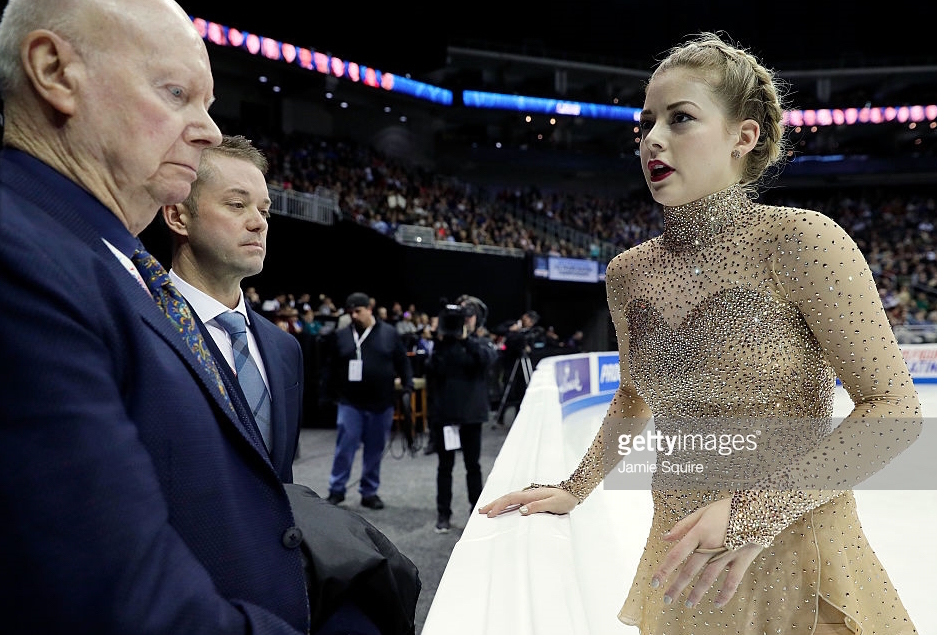
Coach Frank Carroll (left, foreground) and Gracie Gold perplexed again by her subpar performance in Saturday's free skate at U.S. Championships (Getty Images)

Coach Frank Carroll (left, foreground) and Gracie Gold perplexed again by her subpar performance in Saturday's free skate at U.S. Championships (Getty Images)

Gracie Gold stood on a riser 10 yards from the ice surface at the Sprint Center, in an area where athletes who have just finished skating talk to the media. The music for the skater who followed threatened to drown out Gold's words, even as she spoke into a microphone.

Her upper lip trembled a few times, but Gold's voice never cracked as she faced the music again in a season when her skating has struck one sour note after another.

After winning two titles and finishing second twice at the U.S. championships the past four years, Gold had just done a free skate with mistakes on six of her seven jumping passes. She doubled planned triples, singled a planned double, landed one jump on two feet and threw an invalid jump onto the end of a combination.

"Obviously," she said, "I had a very terrible program at the national championships."

Gold was ninth in the free skate, fifth in the short program and sixth overall. She was 35 points from first, 18 from third.

She held her head high, graciously and honestly answering painful questions, but her spirits were low. For the fourth time in four competitions this season, she was trying to understand how the bottom fell out, how she had stumbled to the middle of the pack after being at or near the top of U.S. skating for five years.

"I'm glad this was not the Olympic year," Gold said.

It was too soon to discuss the future, to decide whether she should leave coach Frank Carroll in Los Angeles and return to her previous coach in Chicago or find a completely new environment. Skaters often rush quickly into change after a bad patch, but this slide has been so wide and a dramatic move would not look hasty. And now, with her competition calendar suddenly clear for several months, she has the needed time to weigh all options carefully.

"I'm just not processing the emotions yet," she said. "I'm just choosing not to process them because again there are more bad feelings despite the changes I made and the improvements I made."

Gold said she wouldn't let U.S. Figure Skating down if they chose to give her one of the three ladies spots on the world championships team. Yet, she knew how unlikely that sounded, and, indeed, the team announced Sunday morning included Karen Chen, Ashley Wagner and Mariah Bell, the top three finishers, respectively, at the 2017 U.S. Figure Skating Championships.

"This has been a rough season, but I think I'm still one of the best skaters in the United States and the world," Gold said.

She tried to salvage the season after what would be its lowest ebb, a sixth-place finish at a B-level event in Croatia last month, where Gold received her lowest international scores since 2012. Two weeks of repair work with Alex Ouriashev, the coach she had left before joining Carroll in 2013, had produced encouraging results, but the fixes clearly were short lived.

"It's just something about this year," she said. "I've just been in a funk."

Gold, 21, had been in that funk since last year's world championships, when she won the short program but came undone in the free skate and wound up fourth. She was mercilessly self-critical about that failure and said two weeks ago that it was only during her reunion with Ouriashev that she forgave herself for it.

Carroll suggested Saturday night that the negative effects still lingered.

"She has been in a deep, deep, deep depression," he said.

In a recent telephone conversation, Gold told me the problems were limited to her time on skates.

"I never felt I was in an actual depression and I needed a psychologist," she said. "I was fine out of the rink. It was just in the rink and in skating I wasn't myself.

"I was still a normal human being, regular by all standards," she continued. "I'm just trying to do something above and beyond, trying to be a national champion, a world champion, an Olympic medalist."

She won U.S. titles in 2014 and 2016, and finished fourth at the 2014 Olympics and at the previous two world championships. Yet there was always a feeling she never overcame the confidence issues that held her back until the 2012 season, when she emerged from nowhere to become U.S. junior champion and had people talking immediately of her medal chances at the 2014 Olympics.

The way Gold skated Saturday epitomized how little buffer she has when her confidence is wavering.

She opened with a strong triple lutz-triple toe combination, then had a two-footed landing on her next jump, a triple loop. That relatively minor mistake seemed to provoke a 'here-we-go-again' reaction that deflated her entirely.

A double axel became a single. A triple toe loop was a pop. Both a triple lutz and triple flip wound up as doubles. The switch Gold hoped had been reset to 'on' during the time with Ouriashev kept short-circuiting.

"Even when my switch was on, I just wasn't having the clarity and the confidence to do it," she said. "I opened up with the triple-triple, one of the best starts to a program you can have, and I still didn't do it."

That was the final thing she said before stepping off the riser and walking away. Chen and Wagner were about to skate their way to the top two places in the event and berths on the world team.

Gracie Gold will not skate in competition again until next season.

(This article originally appeared on icenetwork.)

Chen looks like world-beater in short program at skate nationals

It's easy to get carried away at moments like this, to get ahead of yourself, to forget what you have seen is just one performance that lasted just under three minutes, in what was only the first of two phases at a championships event.

And yet what 17-year-old Nathan Chen did Friday night at the 2017 U.S. Figure Skating Championships in Kansas City was so far ahead of its time in the history of U.S. skating that no one wants to wait any longer to envision the medals and titles -- both national and global -- that now seem within his reach.

"I honestly don't think he's going to have to wait his turn," 1984 Olympic champion Scott Hamilton said. "He can beat anyone in the world right now."

Chen already did that in winning the free skate at December's Grand Prix Final. He beat the three men who have won the last six world titles, did it by landing four quadruple jumps cleanly and did it in his debut season on the Grand Prix circuit, winding up second overall in the event to 2014 Olympic and world champion Yuzuru Hanyu of Japan.

His two most recent short programs entering the U.S. championships, however, were badly flawed. That was what made this performance, with its two quads, such an important measuring stick for him -- and led everyone else to start measuring Chen's chances for a world medal this year and an Olympic medal in 2018.

He landed a quad lutz-triple toe combination despite imperfect takeoffs on both, explaining the mishaps by saying, "Part of the program is learning how to fight and secure the jumps that aren't perfect." He followed the combination with a flawless quad flip, then tossed off his nemesis jump -- the triple axel -- with spread eagle transitioning in and out of it. He received maximum levels for his spins and footwork sequence as well.

For the first time, Chen showed a real ability to link skating and dance, which he had studied growing up in Salt Lake City. Skating to the ballet piece Le Corsaire, Chen moved in ways that must have pleased his old teachers at Ballet West Academy.

"It's something I have been striving for the whole season," Chen said of the artistry. "Of course, having the jumps helps that performance quite a lot. I'm glad it finally came together tonight."

It added up to a score of 106.39, breaking the U.S. record of 99.86 set by Jeremy Abbott in 2014. The 42.83 he scored for the three jumping passes was higher than the total technical score of all but two other skaters -- Vincent Zhou (48.53) and Ross Miner (46.21).

Chen's total technical score was 62.07. He has a lead of nearly 18 points over runner-up Miner and nearly 19 over third-place Zhou going into Saturday's free skate, making it a virtually foregone conclusion he will become the youngest men's national champion in 51 years.

"I've never in my long life seen a short program with that difficulty matched with world class artistry," Hamilton said. "I honestly feel he was under-marked.

"This kid is so crazy great and absolutely owns these jumps that everybody else loses sleep over."

Many would have lost sleep facing huge expectations in a competition for the first time, as Chen did here. His performance at the Grand Prix Final started a hum that had grown to a roar in the ensuing six weeks.

"It does add a lot of pressure and a little bit of nerves," Chen said. "At the same time, it gives me a lot more excitement. I feel the praise, and I feel it's something I'm expected to do. I feel like I'm able to deliver."

That does not surprise his coach, Rafael Arutunian, who said Chen has been dealing with expectations at every level of his career, which includes two national titles at each of the novice and junior levels.

"He grew up as a warrior," Arutunian said. "Since he was eight, he was winning his events against competitors usually much older than him. At the junior worlds in 2014, Chen finished third with a cast on his hand. Who does that?"

Chen's performance at the 2016 U.S. Championships, with a third-place finish and four quads in the free skate, had also started a buzz. It died quickly when Chen hurt his hip in the exhibition at the same event, leading to surgery that kept him out of last season's world junior championships and world championships.

Keeping Chen healthy is Arutunian's biggest concern. The coach made a point of saying how much he would like to have the financial means to hire a trainer or physical therapist who could work with Chen every day, an appeal that was clearly directed at U.S. Figure Skating.

Chen has done free skate practices this week with five flawless quads, adding a salchow to the lutz, flip and two toe loops.

"There is no limit," Arutunian said. "We are looking to do more and more. The only scary part is not to get damaged."

Neither Arutunian nor Chen shies away from questions about Chen winning medals or titles at worlds in March or the 2018 Olympics. No U.S. man has earned a senior global championship medal since Evan Lysacek won the 2010 Olympic title.

"I don't think [the medal talk] is something I should be afraid of," Chen said. "It's something I have wanted my entire life. It will bring more energy to my skating versus pulling me down.

"At the Grand Prix Final, I was able to stack up against high-level skaters," he continued. "This short program helps me push that further, to think (of a world medal or title) as a possibility."

Yes, we're getting a bit overheated. But it has been so long since anyone could be carried away by the medal prospects for a U.S. male skater that even the possibility casts a glow.

(This article originally appeared on icenetwork.)