
ISU proposes "radical change" to rebalance figure skating's artistry and athleticism

ISU proposes "radical change" to rebalance figure skating's artistry and athleticism

A top official at the International Skating Union said the organization is looking at "radical change" in figure skating in order to achieve a better balance between the athletic and artistic sides of the sport.

The change would involve substantially lowering the base values of quadruple jumps and, for pairs, quadruple throws. For three of the five quads being done in men's singles, the reduction would be more than 10 percent, according to proposed numbers obtained by icenetwork.

"This is the direction line I am working on with the intent to make a radical change for the future development of the sport, hoping to bring back the popularity that figure skating used to have in the past," Italy's Fabio Bianchetti, the chair of the ISU Single & Pair Skating Committee, wrote in an email.

Another change may include replacing the current short program and free skate with what would effectively be an athletic program and an artistic program. Each would award full medals in events like the Olympics and the world championships, and there also would be a full medal for the all-around winner.

Read More
For Gracie Gold, hope that a step sideways will help her move forward

For Gracie Gold, hope that a step sideways will help her move forward

The first time I met Gracie Gold, in late fall of 2011 at a suburban Chicago rink, she allowed me a glimpse into her psyche after a previous season filled with disappointment.

“I had zero confidence in myself,” she said, refusing to use physical growth as an excuse for the inconsistent jumps that had kept her from qualifying for the 2011 U.S. Junior Championships.

By the time of our first conversation, after her eye-catching performances that season at both a Junior Grand Prix event in Estonia and Midwestern Sectionals, the skating world already was anointing Gold, then 16, as the sport’s next star.

The expectations would be enormous, especially for someone whose psyche always remained fragile.

She bore up to them remarkably well, winning two U.S. senior titles (with two second places), finishing a solid fourth at the 2014 Olympics (with a bronze medal in the team event) and fourth twice at senior worlds.  She built a résumé that would be the envy of nearly every little girl who puts on figure skates and dreams of such achievements.

Of her winning free skate at the 2016 U.S. Championships, I wrote:   "Her jumps were huge and secure, her poise complete, her skating to music from Stravinsky’s `Firebird' a performance that showed the polish of a mature, experienced athlete."  

Little did we know that such performances sometimes masked the truth, that she was a Pagliacci laughing for the crowd while crying inside.

Read More

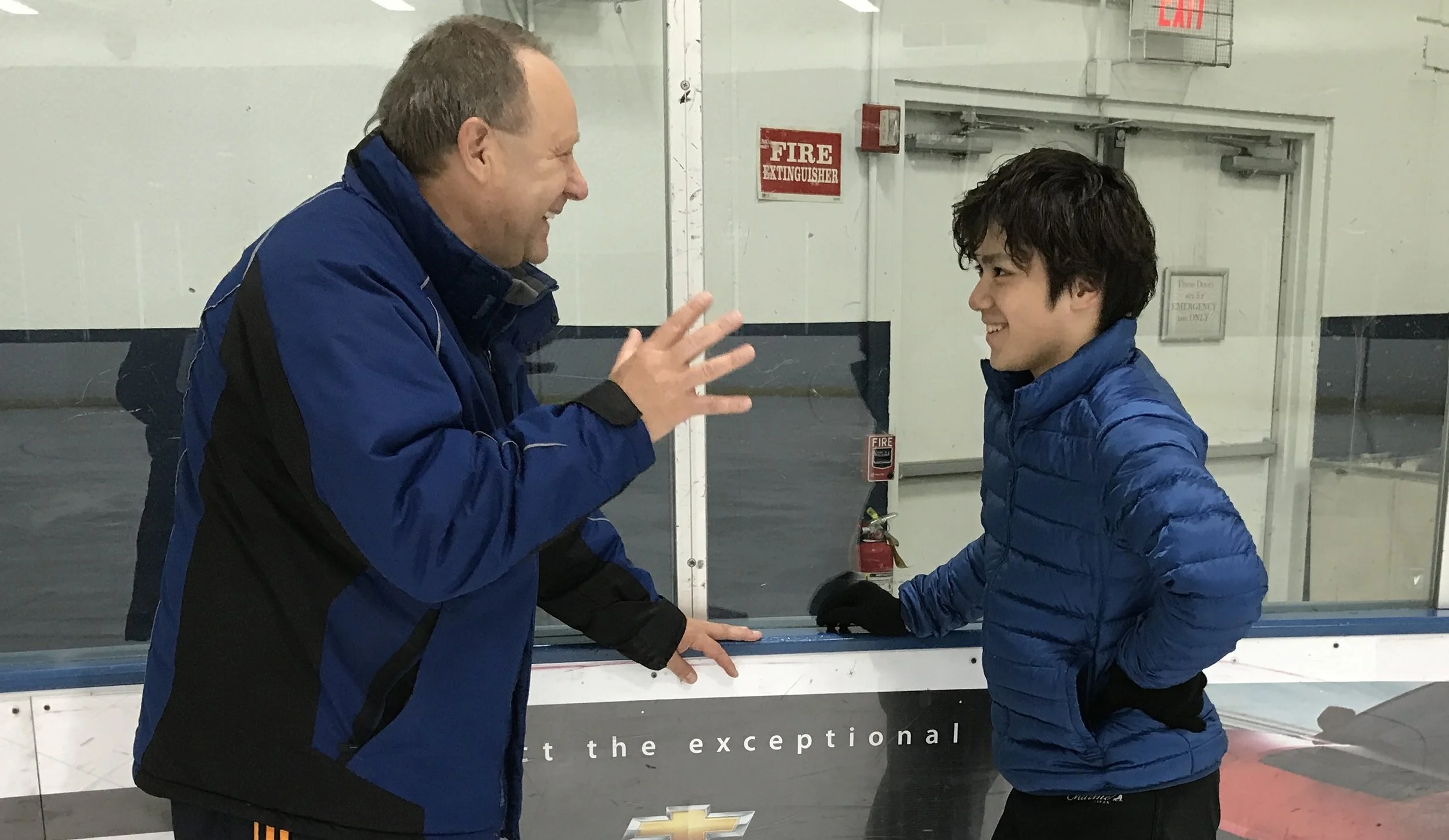
Japanese figure skating star Uno makes big leap(s) with help from U.S. coach

Japanese figure skating star Uno makes big leap(s) with help from U.S. coach

It was a perfect mid-August morning, sunny and dry with a temperature in the low 80s. On such a summer day, most people would do anything to get outdoors.

That is where field hockey player Itsuki Uno, 15, and his father, Hiroki, were going to be. They were headed for the golf course, just as they had almost every day during the Uno family's three-week stay in the Chicago suburbs.

Itsuki's older brother, Shoma, 19, would not be in the golfing party.

"I don't particularly like being outdoors," Uno said through an interpreter, with a sly grin that needed no translation.

Uno was perfectly happy spending his days in an environment that could best be described as anti-summer: the indoor ice sheets at rinks north and west of Chicago, where he was working with the man whose expertise as a jump coach had helped the skater make the podium at all nine of his competitions last season. Five of those were victories, and Uno leaped from seventh at the world championships in 2016 to the silver medal in 2017.

Read More

The week that was for Peter Ueberroth: NBC Olympic Channel, another L.A. Olympics reinforce his legacy

The week that was for Peter Ueberroth:  NBC Olympic Channel, another L.A. Olympics reinforce his legacy

Peter Ueberroth was uncharacteristically understated when I gave him the chance to gloat in a phone conversation last week.

Ueberroth, the man who brought financial stability to the Olympics in 1984 (until recent host cities went wild) and enduring organizational stability to the U.S. Olympic Committee, simply refused to look back.

“I live in the present and future,” Ueberroth, 79, said from his farm in northern Idaho.

He could say, “I told you so,” now that one of his most criticized and roundly dismissed ideas (yes, I was among the critics) to promote the Olympics and Olympic athletes is about to be fully implemented in the United States.

The Saturday debut of NBC’s 24/7/365 “linear” Olympic Channel ("linear" is industry jargon for over-the-air and cable television) validates the actions Ueberroth took nearly a decade ago to create a similar network, no matter that the effort failed in part because of his headstrong approach to pushing it.

Once viewed as Ueberroth’s folly, guaranteed to suck money from USOC coffers, an Olympic Channel has become an integral part of Olympic marketing strategy.

I asked if he felt vindicated.  He parried the question.

Read More

For Abbott, a figure skating career of brilliance and tarnish

For Abbott, a figure skating career of brilliance and tarnish

What to make of Jeremy Abbott’s competitive figure skating career, now that he used a Thursday interview on the icenetwork podcast, “Ice Talk,” to bring it to an official end?

He was a blend of unquestionable brilliance and baffling mediocrity, the latter covering many of his scintillating moments in a dull finish.

With four senior titles, Abbott is among most decorated men’s skaters at the U.S. Championships.  In the past 65 years, only Todd Eldredge has won more national titles (six).  Abbott won all his in the International Judging System era; no other U.S. man has won more than two in that 12-season period, none more than one in the nine seasons since Abbott won his first.

Abbott skated like a world-beater at several of those U.S. Championships, none more so than 2010, when his performances were better than those of the medalists at the Vancouver Olympics a month later.

And he skated at various levels of back-in-the-pack inconsequence in all his global championships, none more so than those 2010 Olympics, when he was 15th (!) in the short program and ninth overall.

Read More