
Figure skating officials weigh major changes in rules, schedule
/
This image is the first page of an ISU document that also contains the two images below.
International figure skating federation officials are weighing changes in competition rules that would alter the sport radically, including a potentially dramatic reduction in jumps in singles events.
And the federation’s governing board, the International Skating Union (ISU) council, has already supported significant changes to the figure skating season schedule and Grand Prix format to take effect in the 2027-28 season.
All this is still in discussion stages but moving forward. Under the new ISU Constitution, the 14-member council (rather than the biennial ISU Congress) has the “ultimate authority to adopt, amend or repeal” competition and event regulations and sports rules.
Questions about the rationales for the contemplated changes drew this email response from an ISU spokesperson:
“ISU will not comment on the various proposals and timelines for discussion but will conclude this process with our members and other stakeholders with a view to announcing the future direction at the end of the season.”
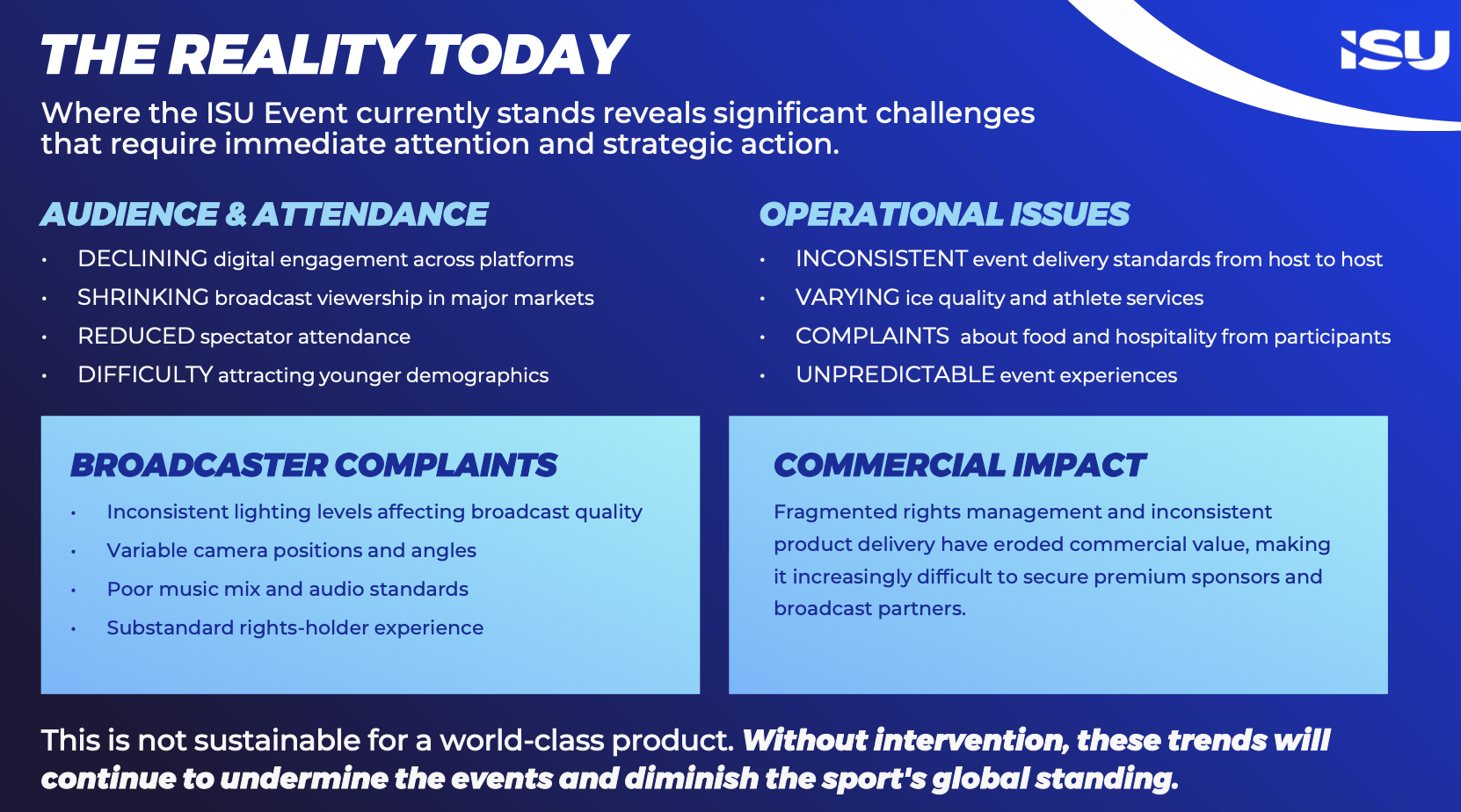
This page (photo below) from an ISU document I have obtained, “ISU Webinar Figure Skating Future Vision 2026+,” outlines in general terms what ISU officials feel is the need for major change as part of a well-intentioned (and Sisyphean?) effort to arrest the substantial decline of interest in the sport over the past two decades.
Some of the changes in program format being proposed look like a heavy-handed attempt to rebalance the emphasis between artistry and athleticism in a sport where the scoring system now puts a high point value on jumps.
You can call this a case of throwing out the baby with the bath water. Or you can call it the Malinin Rules, designed to reduce the huge advantage 2026 Olympic gold medal favorite Ilia Malinin accrues because of his groundbreaking mastery of all six types of quadruple jump and his singular ability, as seen in this season’s Grand Prix Final, to land seven quads cleanly.
Following are the salient points for singles skating, according to people privy to the discussions and two ISU documents. The second document is an agenda with bullet points for the meeting of Grand Prix host federations that took place Dec. 9 in Nagoya, Japan, where the Grand Prix Final took place.
These rules changes, if approved, also could be implemented for the 2027-28 season.
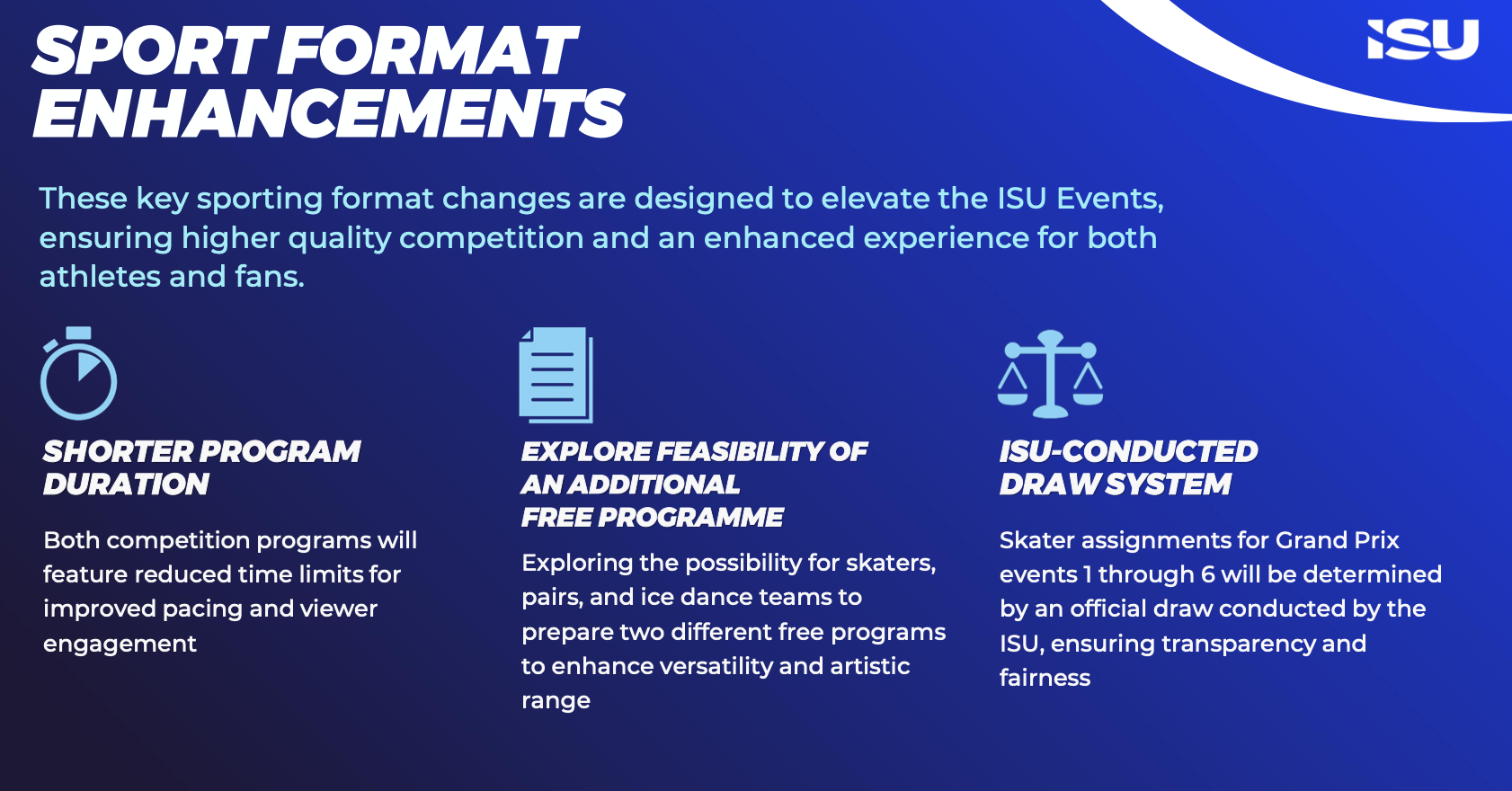
*Under consideration in singles are a “technical” short program of three minutes with a maximum of four jumping passes and an “artistic” free program of three minutes, 30 seconds with no jumps. They would replace the current short program (2 minutes, 40 seconds, with three required jumping passes) and the free skate (four minutes with seven jumping passes.)
Fabio Bianchetti, the ISU technical committee chair for singles and pairs, broached similar ideas in discussions with me in 2017 and 2020. In an email last week, Bianchetti declined to comment on the new ideas, which have yet to become finished proposals.
However, I have learned the technical committee has been charged to develop the “parameters and concepts” of two new programs, according to sources. The ISU Council will make its decisions about the changes in February and have a forum with its members about the decisions at the 2026 World Championships in late March.
*Jumps that end in a fall will receive only 20 percent of their base value. A fall now brings a one-point deduction and grade of execution penalties of up to 50 percent of the base value. The change will likely discourage skaters from trying the most difficult jumps, quads and triple Axels.
*To speed up competitions, the six-minute warmup before each group of skaters will take place off camera. Whether that means on ice or off ice is unclear.
This time saved would allow the ISU to increase the number of qualifiers for the Grand Prix Final from six to eight per discipline and require a broadcast window of just 1 hour, 37 minutes.
The proposed schedule changes, which differ slightly from one document to another (x), are designed to stretch out a season some in the ISU think has become too packed into a seven-week period in autumn. The entire Grand Prix season (six events and a final) currently starts in late October and ends in early December.
The revised Grand Prix schedule would have two “regular” season events in each of September, October and November, then semifinals in December and the final in January. In Olympic years, the Grand Prix would have just four “regular season” events, with semifinals in November and the final in December.
That would likely force date changes in national championships held in late December and January. A number of ISU member federations have indicated opposition to parts of the proposed schedule changes for that reason.
Except in an Olympic year, when the overall calendar would be relatively the same as it is now, the ISU proposes that national championships be held in mid-February, followed by Four Continents and European Championships in March. In all seasons, the World Championships would move from late March into mid-April.
(Challenger Series events, one step below Grand Prix, would begin in September rather than August and end in February rather than December.)
Skaters would be “incentivized” by a new points system to compete in more Grand Prix regular season events (perhaps three per skater or couple instead of the current two.) That could improve the talent level in each Grand Prix field but may reduce the opportunity for many skaters to get a Grand Prix slot.
To address the issue of seeing the same programs over and over throughout a season, skaters might be required to prepare two free programs each season. (The Grand Prix meeting document says they ”must” prepare two free programs; the webinar document refers to “exploring the possibility.” )
Those countries wishing to hold a Grand Prix event may have less of a chance to do so if they don’t have an arena with LED lighting on the boards to increase commercial opportunities. Few mid-size arenas in the world have such lighting, as various member federations have pointed out to the ISU since the idea was revealed in the December Grand Prix hosts meeting.
The impetus for these changes has come from the new management team at the ISU under Jae Youl Kim of South Korea, who was elected ISU President in 2022. New marketing and corporate communications department heads have come on this January as part of what the ISU says is “in line with its ongoing strategic transformation under ISU Vision 2030.”
“The discussions with our members are geared towards the growth of skating for the benefit of the athletes. . .” the ISU spokesperson said. “Putting the athletes’ best interests at the heart of these discussions also means that we are prioritizing opportunities for them that are as engaging as possible for skating’s existing fanbase and new fans that we are targeting through ISU’s various innovations.”
x-A proposal made to the Grand Prix hosts at a December 2005 meeting showed a schedule with the new semifinals in early January and the Final in late January.
