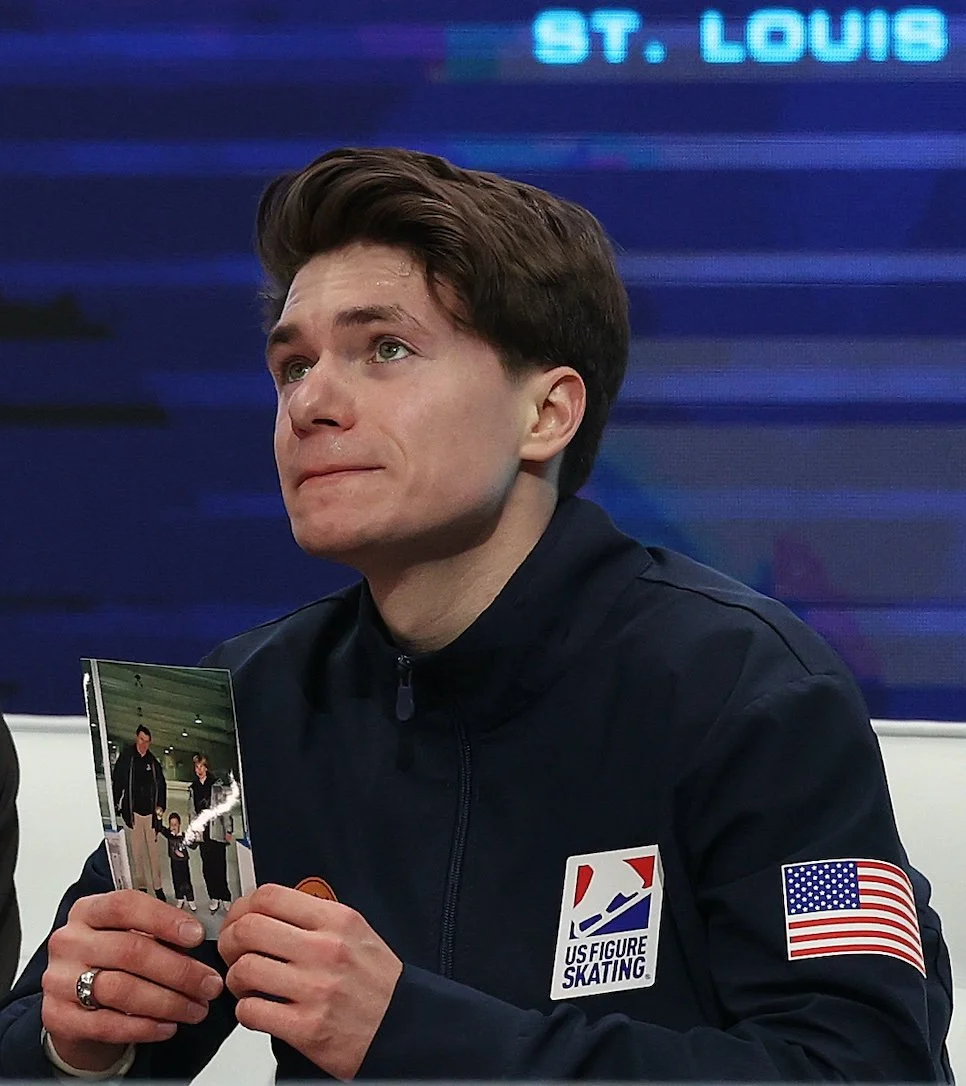
Maxim Naumov channels loss for powerful skate at nationals in Olympic bid

Maxim Naumov channels loss for powerful skate at nationals in Olympic bid

ST. LOUIS, Missouri – Maxim Naumov finished his short program and sat on a white sofa in the area where skaters wait to hear their scores.

With the cameras on him, Naumov held up a photograph of a little boy in white skates standing between two adults on an ice rink in Connecticut. Each adult was holding one of the little boy’s hands to prevent him from falling, the way parents do when their child needs support.

He kissed the photograph - once, twice, three times.

The little boy in the picture was Naumov, who was being introduced to the ice at about age 3.

The adults were his mother, Evgenia Shishkova, and his father, Vadim Naumov, the former pairs world champions and two-time Olympians who had been his coaches until last January 29.

That was the day Max's parents were among the 67 people who died when a U.S. Army helicopter hit their American Airlines jet, which crashed into the Potomac River near Washington, D.C.

Read More

For Japan's Shimada, already a skating star, the Olympics remain a long way off

For Japan's Shimada, already a skating star, the Olympics remain a long way off

What more is there to say about Mao Shimada?

Only that it is too bad the new minimum age rules for international events will keep the 16-year-old Japanese skater from competing in the 2026 Olympics, notwithstanding her having won a record third straight World Junior Figure Skating Championship Saturday in Debrecen, Hungary.

She did it a free skate score of 156.16, highest in the world since the 2021-22 season, seniors and juniors included  - even though junior free skates have one fewer scoring element than senior.

She did with a total score of 230.84 that ranks second in the world this season.  It trails only the 231.88 of her countrywoman, Kaori Sakamoto, winner of the last three senior world titles.  Shimada’s score was the highest ever at junior worlds, topping her 224.54 from two years ago.

Read More

They sparked two decades of U.S. ice dance excellence

They sparked two decades of U.S. ice dance excellence

Not long after Ben Agosto switched from singles skating to ice dance at age 10, he faced up to the reality that winning medals on a global stage might be impossible for a U.S. ice dancer.

Why wouldn’t he think that way, given the evidence?  After all, one of his first coaches, Susie Wynne, had retired from competition after finishing fourth at the 1990 World Championships with Joe Druar, having decided, as she puts it, “We had topped out.  That was the best we could do.”

That fourth place would, in fact, be the best finish for a U.S. team at worlds over nearly two decades since Judy Blumberg and Michael Seibert won their third straight world bronze in 1985, a span in which Soviet and Russian teams won 15 of 18 world titles, four of five Olympic titles and nine of 15 Olympic medals.

Until Agosto and Tanith Belbin ended that drought in 2005.

Read More