
Ilia Malinin tops himself - and skating's record books - once again
/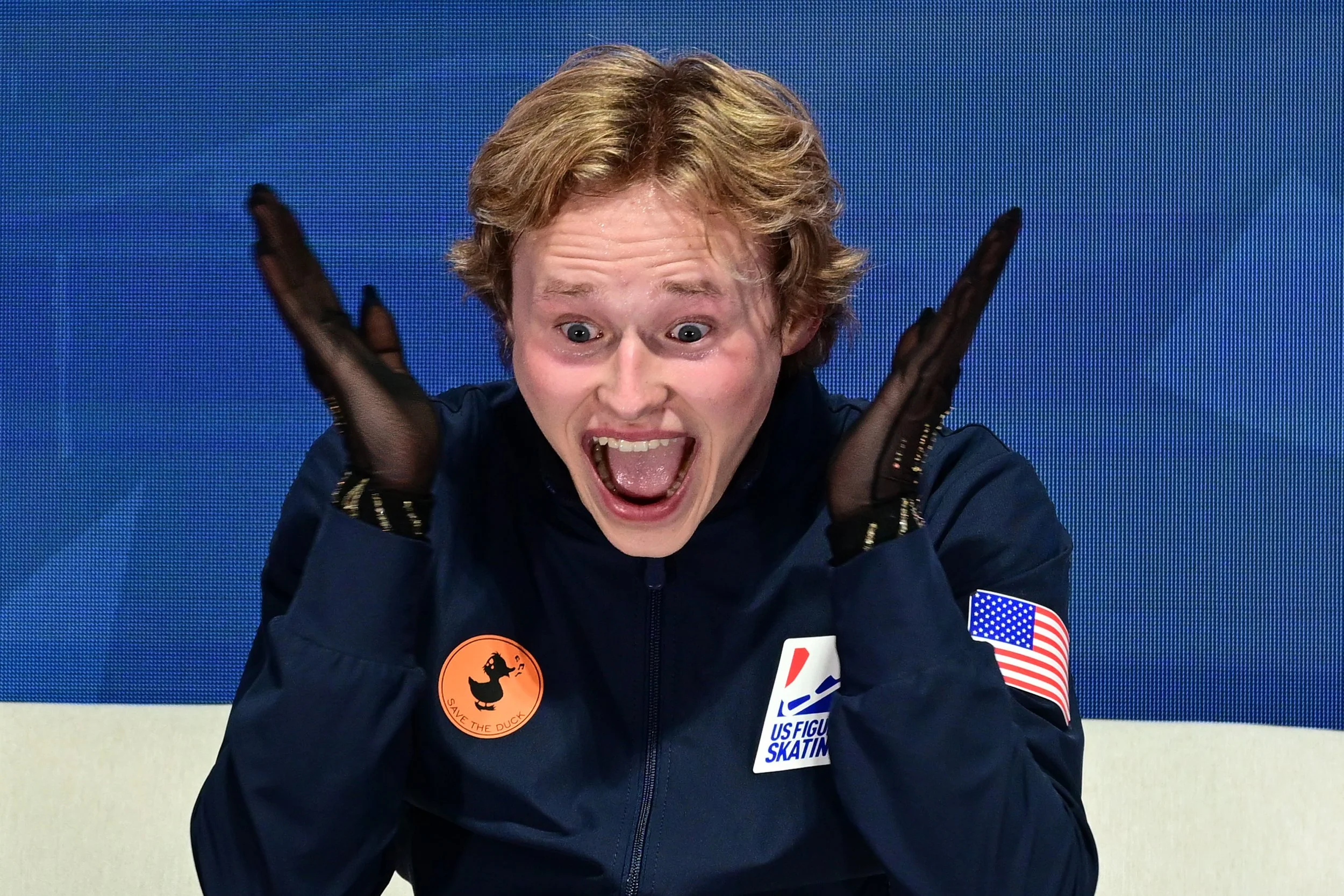
Ilia Malinin reacts to his record free skate score at Grand Prix Final. (ISU photo)
I was tempted to take the last column I wrote about Ilia Malinin, change a few statistics and use that again to describe what Malinin did Saturday in the men’s free skate at the Grand Prix Final in Nagoya, Japan. After all, the guy is in a rinse, repeat cycle of excellence.
This is how that Nov. 2 story began:
“There comes a point in the careers of some extraordinary athletes when they are competing against only themselves and the record books.”
And Malinin beat himself and the record books once more, even after making the men’s competition more interesting when a sloppy short program had left him nearly 15 points behind Japan’s Yuma Kagiyama.
Malinin overcame that with a quadruple jump array that never before had been used successfully in a skating event. And that makes what he did worth a thoroughly fresh look.
Save this score sheet. It is singular now and may remain that way forever – or at least until Malinin lands a quintuple jump, one of which he was attempting (quint salchow) at practice in Nagoya.
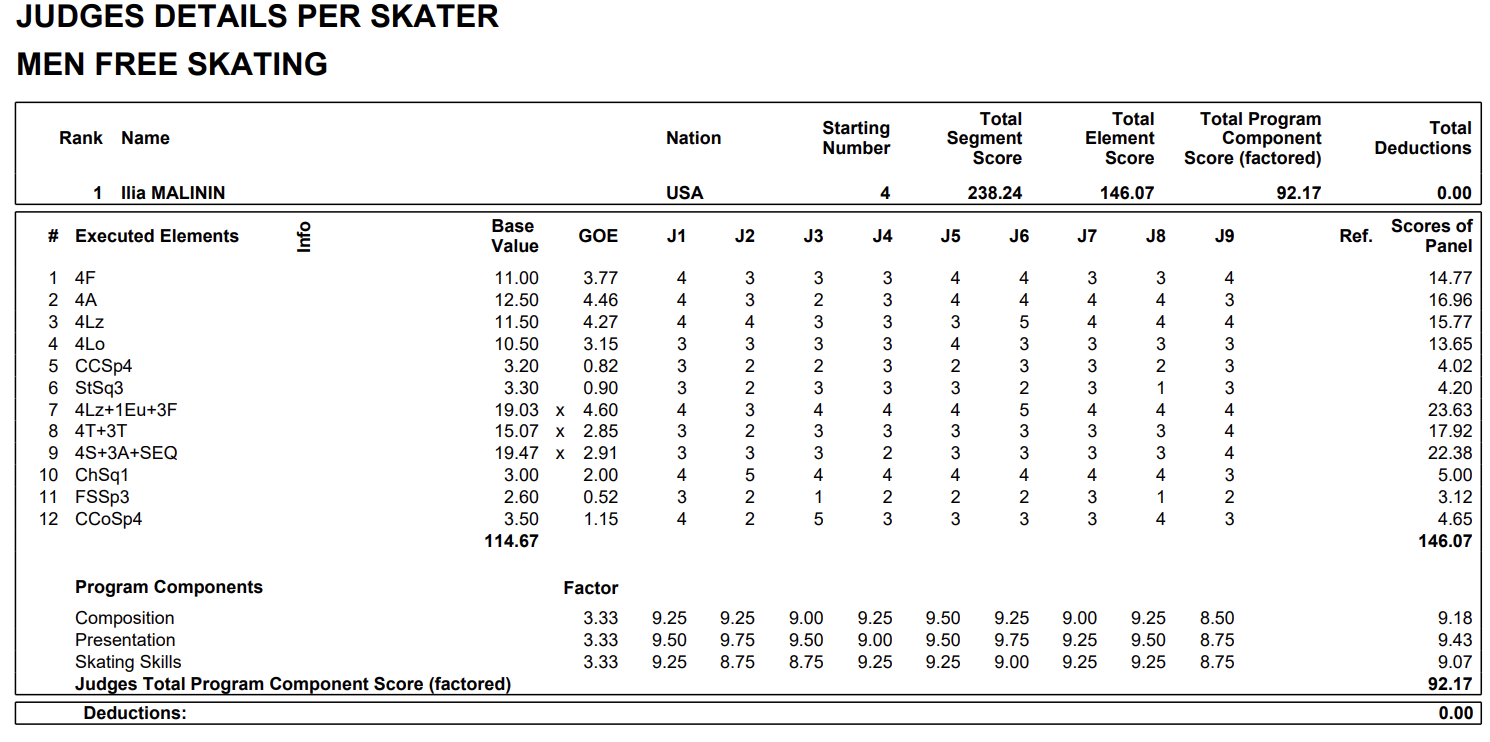
Saturday, he became the first skater to land cleanly seven quads in a program – one of each type, one in each of his seven jumping passes, three leading off combinations. Under figure skating rules, seven is the most quads a skater can attempt in a program.
That added up to a free skate score of 238.24, crushing the record (228.97) he set a month ago at Skate Canada by nearly 10 points. Malinin landed a mere six quads then.
His second quad lutz in the Grand Prix Final started a combination followed by a half-loop and triple flip that received a score of 23.63, highest ever for a single element (he now has the five highest single element scores.) His overall technical element score, 146.07, also was the highest ever, beating the record of 138.49 he had established at this season’s Skate Canada.
That was more than enough for Malinin to overcome his deficit to Kagiyama, whose less ambitious program included two mistakes that dropped him to fourth in the free skate and second overall at 302.41. Malinin’s 332.29 total came despite easily his worst short program score (94.05) since the Grand Prix Final four seasons ago. He has won the last three Finals.
Malinin’s free skate score was 43.52 points higher than that of Italy’s Daniel Grassl, second in the free and fourth overall. That is the largest free skate margin in any event with the elite assembled – Olympics, World Championships , Grand Prix Final.
“I was not expecting that score, “ Malinin told the media in Nagano. “I felt like my program was at 90%, so there's always more to work to do to keep going.”
One of his spins and his step sequence were judged level 3 instead of the maximum level four. His final spin, after expending vats of energy on the jumps, got a level four.
“I put up such a fight,” said the 21-year-old Virginian. “It was really a struggle to get through one element to the other but I fought all the way to the end. . . Now the next goal is to be able to complete all the jumps but also be able to polish more of the program.”
(All three reigning world champions from the U.S. won GPF gold. Alysa Liu took the women’s title in her debut at the event, and Madison Chock-Evan Bates their third straight dance title,)
Complain all you want about skating’s ever growing emphasis on jumps. Nitpick all you want about how the judges are swayed by Malinin’s jumping to award him higher component scores.
His jumping is not only an unmatched skating skill but also his way of presenting a winning program, just as jumping and boundless joy were for Tara Lipinski when she won the 1998 Olympics. He is an athlete for Generation Z rather than for the Baby Boomers who still are a very large slice of skating fandom.
Winner of the last two world titles, Malinin will go into February’s 2026 Winter Olympics as the overwhelming favorite. A fourth U.S championship in next month’s nationals is an even more foregone conclusion.
Everyone should revel in watching a generational talent, one who is taking full advantage of the way the sport is scored and judged today, one who has leapt past presumed athletic barriers. Malinin is sui generis, one of a kind, one who seems to always respond to the problem of topping himself with another dramatically correct answer.
