
U.S. Figure Skating will ask ISU to review system that led to ice dance judging controversy
/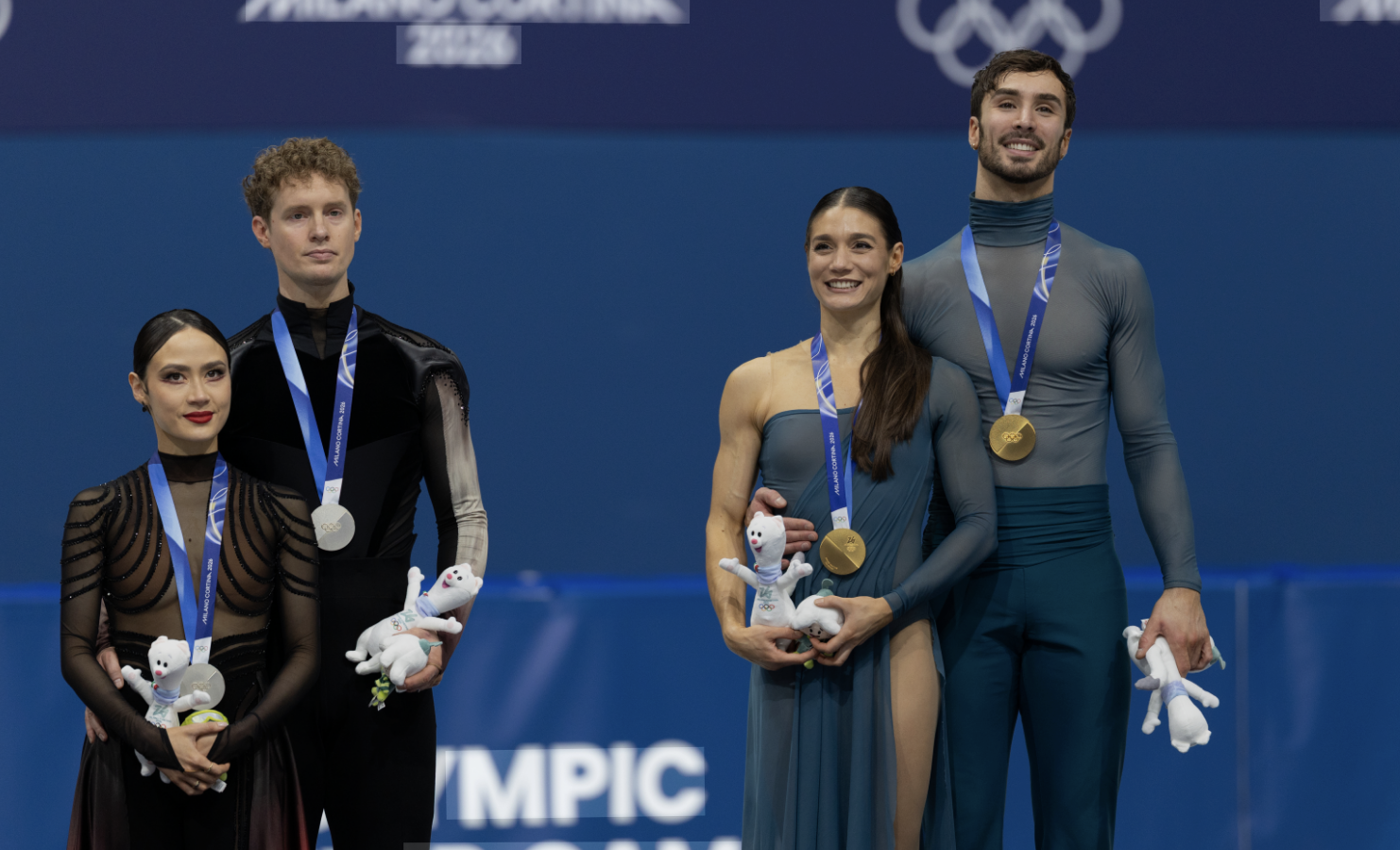
Madison Chock and Evan Bates (left) and Laurence Fournier Beaudry during the ICE Dance awards ceremony.
U.S. Figure Skating intends to send a letter to the International Skating Union asking for a review of the judging system that essentially allowed one judge to determine the outcome of the 2026 Olympic ice dance competition, a person familiar with the situation told me Friday.
The result was a narrow victory (1.43 points) for French couple Laurence Fournier Beaudry and Guillaume Cizeron over U.S. team Madison Chock and Evan Bates.
“We don’t expect a reversal,” the person said. “We are doing this in support of our athletes.”
The judge in question is Jézabel Dabouis of France, who scored the French team nearly eight points higher in the free dance (137.45) than she did Chock and Bates (129.74), according to data compiled by skatingscores.com.
But Dabouis’ scores for Cizeron and Fournier Beaudry were not only 7.71 points higher than those she gave Chock and Fournier Beaudry, they were also the only scores over 130 she gave any of the 20 competitors in the free dance.
Five of the nine judges had Chock and Bates ahead of Fournier Beaudry and Cizeron.
“The numbers really tell the story,” the person said. “Chock and Bates had 5 of the 9 firsts so the only way for the French to win was for the French judge to spread the points as far as possible, which she did.
“Essentially she made the decision for the panel. This is not right and (the) judging system should guard against that.”
A letter making some of those points will likely be sent over the weekend.
Mathematical comparisons of judges are somewhat inexact because the scores that determine the result drop the high and low scores from the nine judges on each element and component, and it is not possible to determine whose scores were dropped in cases where more than one judge had the same high or low mark.
Dabouis also gave the eventual gold medalists a significant (5.74 points) advantage over Chock and Bates in the rhythm dance phase of the event. Her score for Fournier Beaudry and Cizeron (93.34) was the only one over 87.6 she gave anyone.
When all the scores were tallied Fournier Beaudry and Cizeron won the rhythm dance by .46 and the free dance by .97.
In a statement sent to me Friday, a spokesperson for the ISU said, "It is normal for there to be a range of scores given by different judges in any panel and a number of mechanisms are used to mitigate these variations. . .The ISU has full confidence in the scores given and remains completely committed to fairness.”
Chock and Bates, winners of the last three world titles, clearly were perplexed by the result, but they accepted it with equanimity in talking to the press Wednesday.
“Sometimes you can feel like you do everything right and it doesn't go your way,” Bates said. That’s life, and that's sport, and it's a subjective sport. It's a judged sport.
“But I think one fact that is indisputable is that we delivered our best, we skated our best. The rest is not up to us.”
