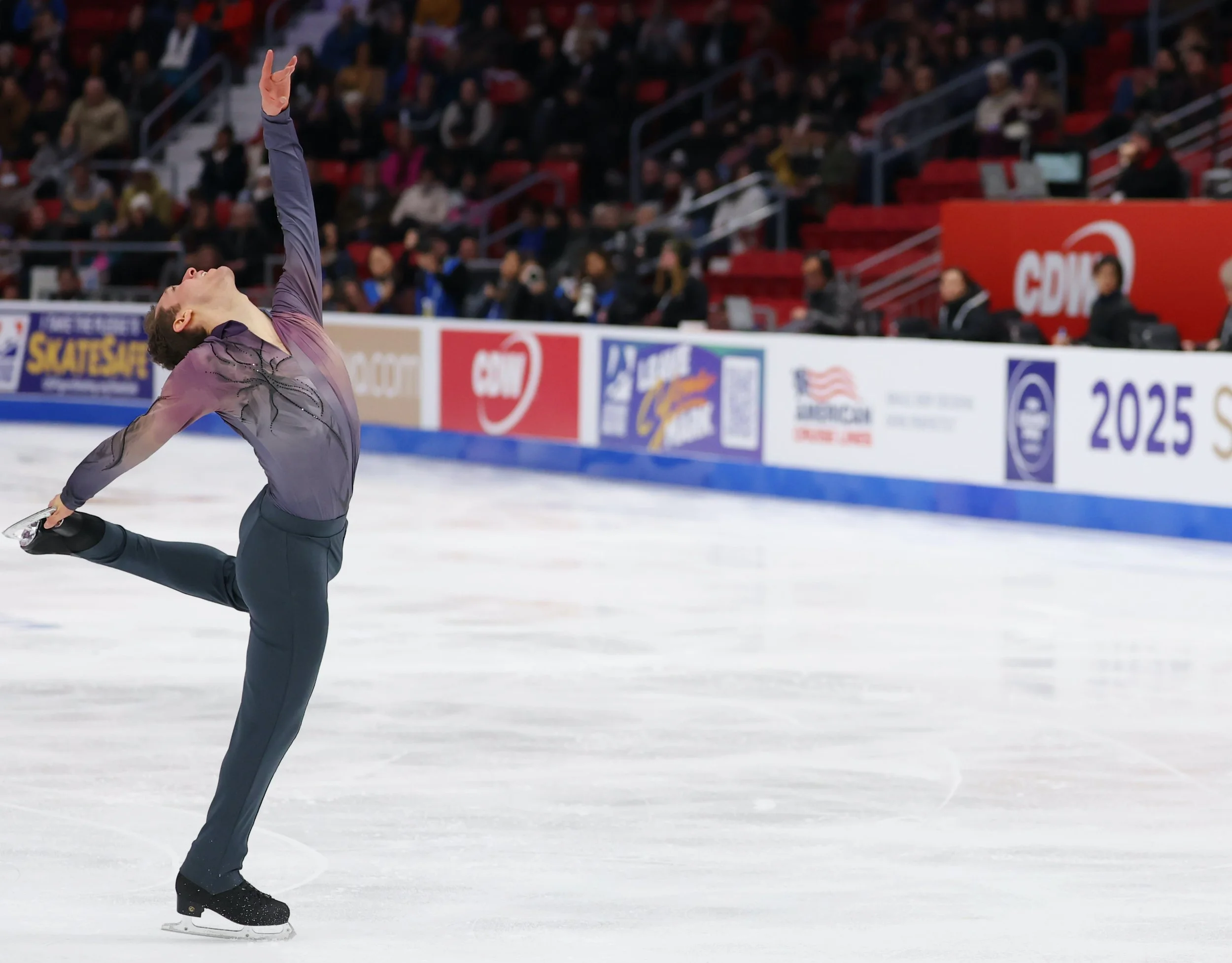
Jason Brown finds pursuit of perfection a frustrating need

Jason Brown finds pursuit of perfection a frustrating need

LAKE PLACID, N.Y. – There are some who would presume that Jason Brown’s universal acclaim as a performer would be enough accolades for him.

That could not be further from the truth.

“I’m competitive, and I really want people to take me seriously,” Brown said.

That means getting good results as well as the loud applause he heard throughout his 2-minute, 45-second short program at Saatva Skate America, the U.S. stop on the sport’s Grand Prix Series.

To do that, Brown cannot have mistakes like those on two flawed triple jumps. They left him in a distant 5th place in a field of 12 heading into the free skate, when those ahead of him will have even more wiggle room because there are more jumping passes to use for quads.

Read More

Madison Chock and Evan Bates find appreciation in swan song Olympic season

Madison Chock and Evan Bates find appreciation in swan song Olympic season

They have been around the competitive ice dance world so long it would be easy for Madison Chock and Evan Bates to develop a sense of ennui, a sense of been there, done that, of thinking how can their 1,000th practice or seventh appearance at the U.S. stop on the Grand Prix circuit be anything more that a forgettable way station on the trip to their ultimate goal.

It's just such an attitude that the winners of the last three world titles have been consciously rejecting as they prepare to skate together in a fourth Olympics this February in Milan, Italy, where they would seek the one thing missing from their sparkling résumé: an ice dance Olympic medal (preferably a gold one.)

Read More

They sparked two decades of U.S. ice dance excellence

They sparked two decades of U.S. ice dance excellence

Not long after Ben Agosto switched from singles skating to ice dance at age 10, he faced up to the reality that winning medals on a global stage might be impossible for a U.S. ice dancer.

Why wouldn’t he think that way, given the evidence?  After all, one of his first coaches, Susie Wynne, had retired from competition after finishing fourth at the 1990 World Championships with Joe Druar, having decided, as she puts it, “We had topped out.  That was the best we could do.”

That fourth place would, in fact, be the best finish for a U.S. team at worlds over nearly two decades since Judy Blumberg and Michael Seibert won their third straight world bronze in 1985, a span in which Soviet and Russian teams won 15 of 18 world titles, four of five Olympic titles and nine of 15 Olympic medals.

Until Agosto and Tanith Belbin ended that drought in 2005.

Read More

Gracie Gold faces her traumatic past in stunningly candid memoir

Gracie Gold faces her traumatic past in stunningly candid memoir

It is tempting to see Gracie Gold’s story mainly as a compelling cautionary tale about the mental health risks of a sport in which the pursuit of excellence must start when athletes still are children.

It is also tempting to see Gold’s story as sui generis, the result of a childhood, adolescence and young adulthood spent in a family whose dysfunction she describes with raw detail in the memoir, OUTOFSHAPEWORTHLESSLOSER, published Tuesday.

Seeing it as one or the other would be a simplistic reaction to a story so complex it recalls a landmark 1957 movie, “The Three Faces of Eve.”

Rather than Eve’s multiple personalities, Gold had three different personas.

Read More