With four Olympic medals, Kaori Sakamoto didn't need gold to cement her legacy

With four Olympic medals, Kaori Sakamoto didn't need gold to cement her legacy

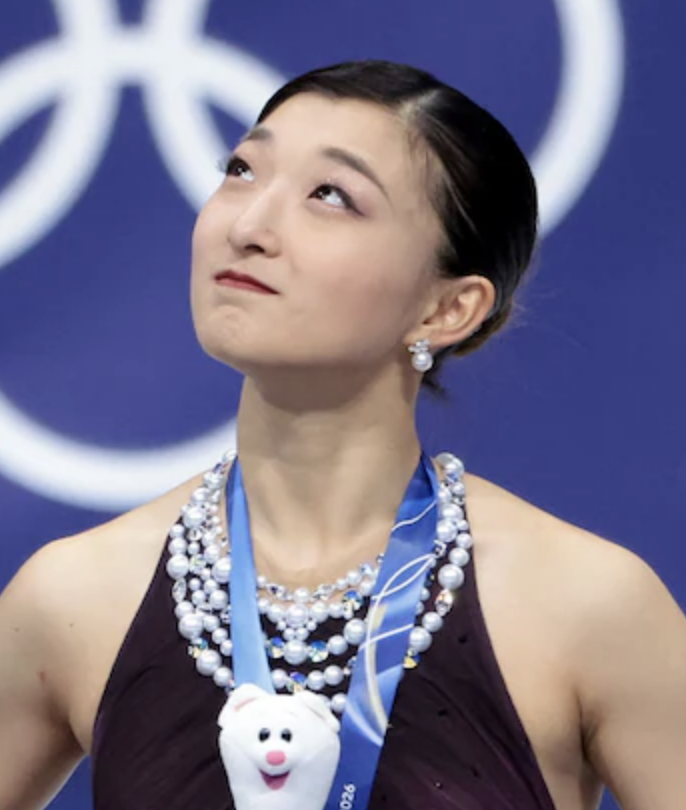
Kaori Sakamoto knew well before the scores were announced. She skated off the ice Thursday night at the Milano Ice Skating Arena with a glum expression on her face. She could sense that the one jump she couldn’t pull off in her free skate was going to keep her from the gold medal.

Alysa Liu, the soon-to-be champion, got up from the leader’s chair as soon as Sakamoto left the ice surface. Liu hugged Sakamoto tight and long. A tear worked its way slowly down Sakamoto’s right cheek. More tears would flow later from the most decorated women’s figure skater in Japanese history.

“I really wanted to skate perfectly here,” Sakamoto said via an interpreter. “Knowing that I couldn’t, and it was the difference for the gold, was painful. I couldn’t stop the tears.”

This was her third and last Winter Olympics. The second, four years ago, had also ended in tears so strong her body shook as she wept. Those tears looked like a mixture of happiness over winning what she calls “a miracle” bronze medal and relief over simply surviving the chaos surrounding the women’s singles event in Beijing.

Read More

Bradie Tennell returns to U.S. Figure Skating Championships after nightmarish comeback

Bradie Tennell returns to U.S. Figure Skating Championships after nightmarish comeback

Bradie Tennell was ready. Her bags were packed for an early October trip to the Japan Open, an event that had would have symbolic resonance for her. It was to bring a traumatic part of her life full circle toward its end.

Tennell would be returning to figure skating competition in the same country where she had last competed 20 months earlier, at the 2021 World Team Trophy, before a right foot injury that frustratingly defied diagnosis.  The two-time U.S. champion had missed an entire competitive season, missed a chance at going to a second Olympics, missed the part of her identity that was Bradie Tennell the athlete.

It was the day before she was to leave for Japan. Tennell was practicing at her new training base in Nice, France, where she moved last September from her home in suburban Chicago (before her injury, she had been training in Colorado Springs). She was hoping such a dramatic change could bring renewed energy to her oft-delayed comeback.

Tennell had been training well, regularly doing clean program run-throughs in practice. She had been able to work her way back slowly and deliberately, with a schedule that allowed her to be patient.

And then, in her words, “something weird” happened on the landing of a triple toe loop jump. And now she had pain in her left foot, and the trip to Japan was off, as was a planned trip to Hungary for the Budapest Trophy a week after the Japan Open, as was … another season?

Read More

Valieva case spotlights an old question in figure skating: Will age minimum be raised?

Valieva case spotlights an old question in figure skating: Will age minimum be raised?

Would raising the minimum age in figure skating prevent another Kamila Valieva situation in the future?

It would not directly deal with the issue of doping that is at the center of this highly controversial case, which has utterly overshadowed the 2022 Winter Olympic figure skating competition for the week since it became public.

But it would address part of the multi-layered problem that may have contributed to Valieva, 15, having a banned drug, trimetazidine, appear in a doping control sample she gave Dec. 25.

Olympic champion Nathan Chen’s coach, Rafael Arutunian, has advocated raising the age minimum for several seasons. He thinks the Valieva case will put more pressure on the International Skating Union to do it.

“If you are skating in an adult competition, you should be an adult,” Arutunian told me this week via telephone.

NBC Olympics has confirmed a Russian TV report that the ISU governing council will put forward a proposal to raise the minimum age for Olympic-level (senior) international competition on the agenda of the ISU congress in June. The minimum would go from 15 to 17, cover only figure skating and be phased in.

Read More

Nathan Chen makes a statement with commanding short program in Olympic team event

Nathan Chen makes a statement with commanding short program in Olympic team event

Nathan Chen’s short program to the Charles Aznavour song “La Boheme” includes a passage with an expressive emotional release, his mouth clenched into a grimace, his eyes afire with the passion and longing of the artist the lyrics describe.

The emotion in that choreographed expression during the team event short program Friday morning at the 2022 Winter Olympics also spoke of a different release than the one Chen needed simply to inhabit the role he was interpreting.

Chen seemed to be letting go of all the frustration and disappointment that had followed his stunningly poor performances in the team event and individual event short programs during his Olympic debut four years ago.

“It feels good to have a short program that I actually skated well in an Olympic experience,” Chen said.

Read More

Present and future shock in sparkling nationals short program, with Ilia Malinin bursting into Olympic contention

Present and future shock in sparkling nationals short program, with Ilia Malinin bursting into Olympic contention

In a span of less than 15 minutes, everyone watching the men’s short program at the U.S. Figure Skating Championships saw a summary of the last decade in men’s singles skating.

You had a 17-year-old, Ilia Malinin, whose Instagram handle is @quadg0d, burst onto the senior nationals scene with a demonstration of why that choice of sobriquet was not self-aggrandizing and how fast a mastery of big jumps can push a skater toward podiums at significant events. He is a young man for these times in the sport.

And next you had a 27-year-old, Jason Brown, who competed in his first senior nationals 11 years ago, using his mastery of movement, expression and edge work as he fights to stay on podiums without the big jumps that bring big rewards in the sport’s judging system. His skating is timeless and yet relatively out of fashion on contemporary score sheets.

Malinin and Brown each was brilliant in his own way during a competition Saturday in which the overall level was extraordinary, with Nathan Chen and Vincent Zhou taking command at the top and others, like Jimmy Ma and Camden Pulkinen, earning career-best scores with performances that commanded full attention.

“That was a pretty incredible competition,” Zhou said, “not just in U.S. history but in relation to ISU international competitions. Definitely an insane, high-level event.”

Read More