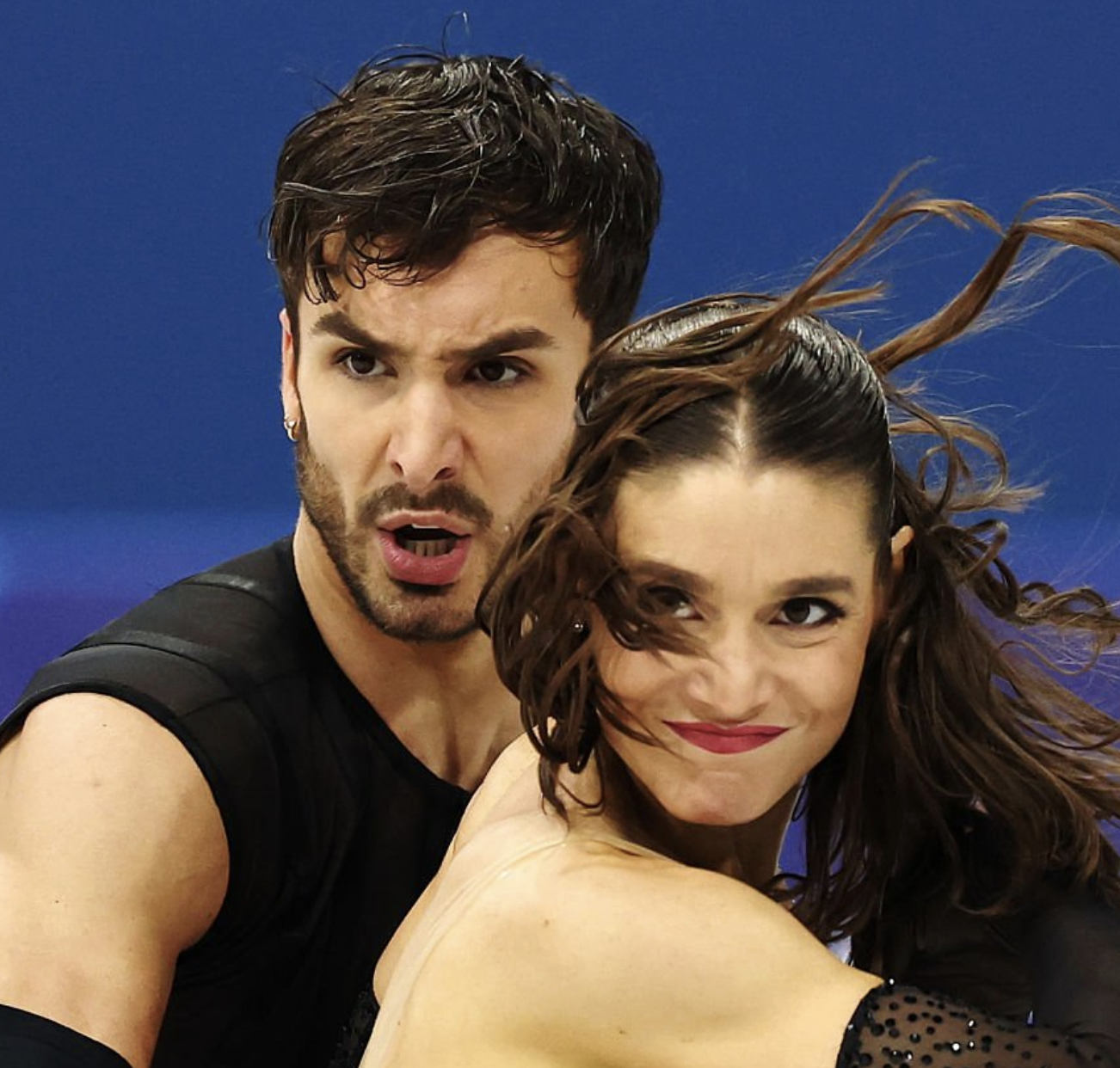
French team defying timelines for ice dance success

French team defying timelines for ice dance success

It’s not supposed to happen this way in ice dance, having two skaters who teamed up less than a year ago leading the Olympics after the rhythm dance.

After all, the last three Olympic champions all had skated together seemingly forever, beginning when they were children: 18 years for 2022 gold medalists Gabriella Papadakis and Guillaume Cizeron of France; 21 years for 2018 winners Tessa Virtue and Scott Moir of Canada; 17 years for 2014 winners Meryl Davis and Charlie White of the United States.

"Longevity is incredibly important because of how complex both the training relationship and competitive relationship is, especially in ice dance, since the elements are so nuanced, and there’s so much relying on the performance and emotional chemistry," Ben Agosto, 2006 Olympic silver medalist with Tanith (Belbin) White, told me when Papadakis and Cizeron won.

And yet here we are, with Cizeron and his new partner, freshly minted French citizen Laurence Fournier Beaudry, beating three-time reigning world champions Madison Chock and Evan Bates of the United States by two whiskers in Monday’s opening phase of the 2026 ice dance event. It concludes with the free dance Wednesday.

Read More

Figure skating at 2022 Olympics a trip - from sublime to absurd to sublime

Figure skating at 2022 Olympics a trip - from sublime to absurd to sublime

It all started routinely, with a team event in which the medalists finished in the expected order (ROC-USA-JPN), and Russian Olympic Committee’s Kamila Valieva unsurprisingly became the first woman to land a quadruple jump in the Olympics.

After that, the 2022 Winter Olympics figure skating competition went from the sublime to the absurd to the sublime.

The team event was over only a day when the cancellation of its formal medal ceremony led to a week in which doping (especially Russia’s doping), pitiless training methods and the sad collapse of Valieva, the 15-year-old at the center of the story, turned into a firestorm as depressing as it was devastating.

Within a few hours of a story by Olympic specialist website Inside the Games that a legal issue about doping had prevented the team event medals from being presented, the website reported the case involved Valieva, the heavy favorite in women’s singles.

Valieva’s positive doping result from a December test, the bureaucratic laxity that followed, the decision that allowed her to compete in singles – it all brought recrimination, tears, anger and numbness as Valieva staggered under the weight of it, and the world watched in dismay.

How sadly bizarre was it that Court of Arbitration for Sport rulings on figure skating matters were as significant as nearly anything that happened on the ice?

Read More

Papadakis and Cizeron rely on years together to reach gold

Papadakis and Cizeron rely on years together to reach gold

Gabriella Papadakis and Guillaume Cizeron were kids when they each began skating at the same rink in central France, where her mother, Catherine, was an ice dance coach and his father, Marc, the president of the local ice dance club.

They still were kids when Catherine Papadakis thought that they could make a good dance team.

They were both then 9 years old. They would be skating partners for the next 18 years, through adolescence, a move to Canada eight years ago, injuries and the challenges of COVID-19.

The length of that partnership had a significant impact on allowing them to perform as they did Monday in Beijing, winning the 2022 Olympic gold medal with an artistry that has made them one of the most compelling teams in the history of ice dance.

Read More

No Grand Prix Final leaves competitive questions unanswered - and some uncertainty about upcoming competitions

No Grand Prix Final leaves competitive questions unanswered - and some uncertainty about upcoming competitions

I love figure skating’s Grand Prix Final. It has six elite entries in each senior discipline, based on qualifying from results on the six-event Grand Prix circuit. No competition session lasting more than an hour, unlike the three-plus-hour sessions at the Olympics and World Championships. And over the years, many stunning performances and record scores.

So, like all those who are interested in the sport, I was disappointed by the Covid-related cancellation of the event scheduled to begin Thursday in Osaka, Japan.

It is the second straight year the global pandemic has led to the Grand Prix Final being cancelled. Last season, the entire series was changed to domestic-only events.

This one would have let us see whether Nathan Chen, invincible from the 2018 Olympics until finishing third at Skate America in October, could win a fourth straight GPF title and reestablish himself as the clear favorite for the upcoming Beijing Olympics. And whether the latest Russian female phenom, Kamila Valieva, could continue her record-setting dominance. And whether the evergreen Chinese pair, Sui Wenjing and Han Cong, could hold off the top Russians. And whether French ice dancers Gabriella Papadakis and Guillaume Cizeron would gain a winning edge over their top rivals before Beijing.

Those questions will go unanswered for the time being. And that leaves questions about competitions to come.

Read More